May 1, 2016
Apr 3, 2016
Apr 2, 2016
Driveclub - Time Trial - Koenigsegg One:1 - Takahagi Hills, Japan
-- https://plus.google.com/+McclarendesignBlogspotGTReviews/posts
-- https://player.me/mcclarendesign
-- https://www.youtube.com/user/CarOfTheWeekNStuff
-- http://www.tsu.co/McClarenDesign
-- https://www.purelyonlineracing.com/user/McClarenDesign
-- https://twitter.com/mcclarendesign
-- http://www.twitch.tv/mcclarendesign
Interested in using a video game replay for your company?
This is a sample of my work, commissioned by Redwood (http://www.redwoodlondon.com/) on behalf of Mazda - http://www.zoomzoommag.com/issue24-2015#!pixel-power
To inquire about video game replay footage, or for consultation about racing video games and the American video game market, please email me at McClarenDesign@gmail.com.
If you'd like to show your support with a donation, visit: https://www.paypal.me/McClarenDesign. Please also note that all donations are used to improve recording/rendering equipment, game play and console equipment and peripherals, and whenever possible saved towards attending VidCon 2017 and/or 2018 (http://vidcon.com/).
McClarenDesign is a proud supporter of Sauber F1 Team. - http://www.sauberf1team.com/en/


Mar 8, 2016
Dec 22, 2015
Mar 2, 2014
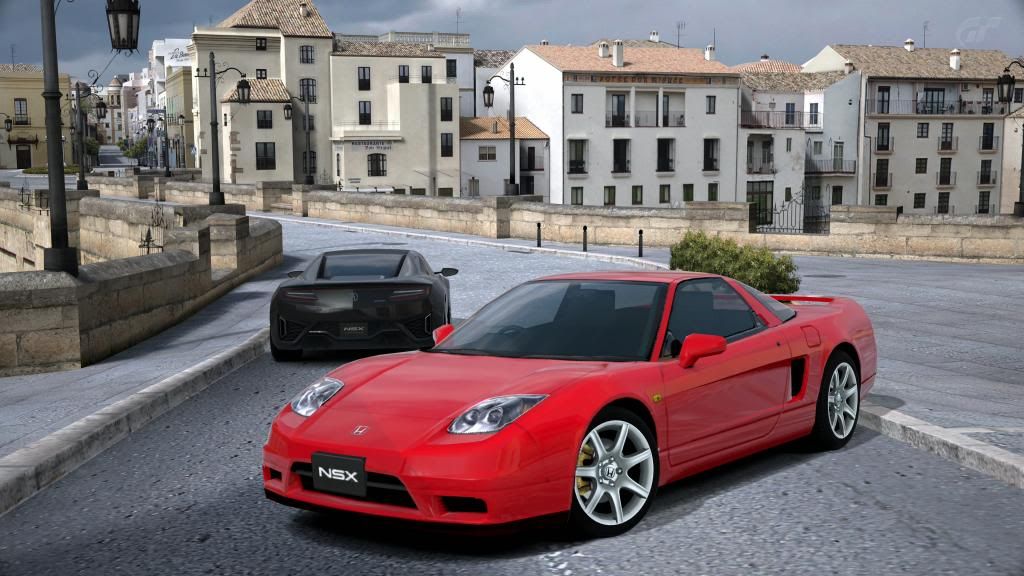
Week 9: 2001 Acura/Honda NSX vs 1993 Acura/Honda NSX
"He didn't want to beat me, metaphorically he wanted to destroy me." -Alain Prost
Men don't cry. It isn't that we're incapable of emotion, it's because crying implies weakness, and weakness simply will not be tolerated amongst the pack. Since man's first encounter with a dinner that wasn't first planted, any notion of expressing discomfort amidst hardship is strictly forbidden. Doing so only shows everyone that you aren't as strong as they are, and may very well end up being the one that gets everyone killed. While not exactly as elegant as something written by Hawking or Einstein, the theory does hold some merit. It's not difficult to imagine how successful you'd be sneaking up on a jaguar while sniveling about a broken nail. Instead of hunting dinner, you'd likely find that the roles were reversed, with a giant feline ready to use your soon-to-be corpse as a plaything.
Just because a few millenniums have past doesn't necessarily mean that anything has changed. If anything, evolution has rewarded such behavior, creating Alpha males bent on conquering anything in site just to prove their machismo. At some point someone thought it a good idea that men stop killing each other just for kicks and invented sports, the thought being that a reward would be more satisfying that murdering one's opponent. Today that tradition continues, with over-rewarded Alpha males clashing on various fields, often violently, just to prove their superiority over the male standing next to them. And just like our cave dwelling days, there's still no crying allowed, even in baseball.
Because I'm discussing this topic, I'm bound to appear as being sexist. In today's age of political correctness, it's considered taboo to discuss the differences between the sexes. But facts are facts, and the truth of the matter is that fundamentally there are many differences between the two. While women apply 10,000 different health and beauty products to attract a suitable mate, men just bash whatever happens to be near by with a stick or club. Instead of pondering the aesthetics of matching or contrasting colors and patterns, we use the biggest tools available to erect a structure for those very same colors and patterns, but mostly just for shelter. Despite countless years of progression and evolution, we still play the same illogical games in order to attract a mate, and the different sexes go about this in very different, observable ways.
Much like logic, justice plays absolutely no role in how we go about our business, because society simply doesn't have time for it. For instance, when I was told that we'd be testing our fourth Japanese car in a row, I had every right to bitch, moan and complain. But I can't. Doing so would immediately lead to accusations of being weak, at best, and this column doesn't seem the appropriate place to prove that I do not, in fact, have sand in my vagina. Although I haven't witnessed my best friend's head being blown off on the battlefield or managed to nail my hand to a wall, it is expected of me to carry on in the same manner, unfazed. No matter the hardship or difficulty, showing discomfort proves weakness, and I'm not about to start now.
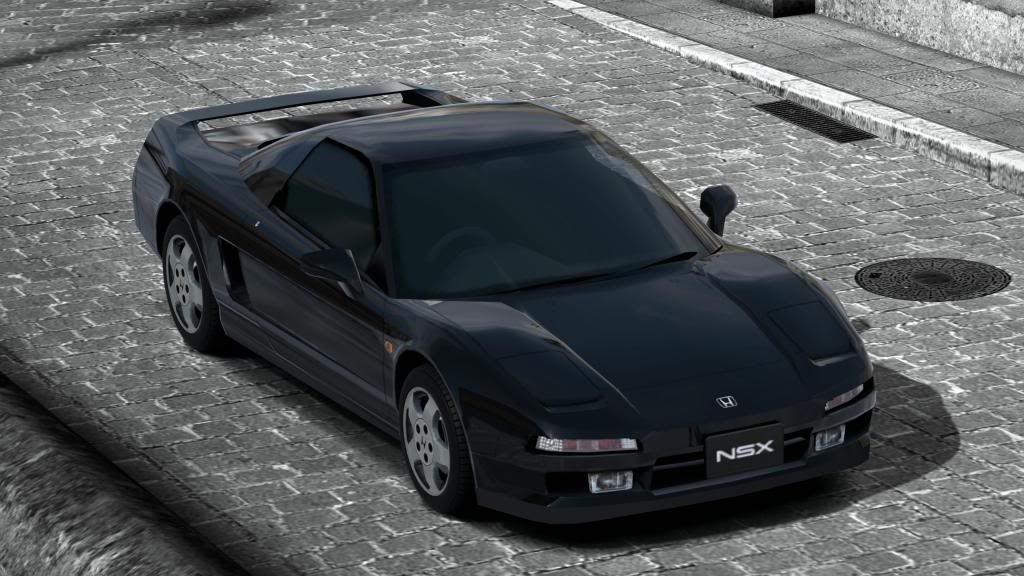
According to Polyphony Digital (via Translator-san):
"Until Honda introduced the Acura NSX, mid-engine sports cars, while providing an ideal degree of balance and weight distribution, were generally not the most comfortable place to be for both driver and passenger. The emphasis on these cars was usually on all out performance, not luxury. But the NSX was different; it was a world-class performance machine that also incorporated a remarkably high level of ergonomic comfort. it was truly an exotic car that provided enthusiasts the best of all worlds."
"A high-revving, normally aspirated 3.0-liter DOHC V6 was located just aft of the passenger compartment for superior handling balance. This powerplant was the first to incorporate VTEC, the company's revolutionary variable valve-timing technology that was developed from Formula 1 technology. The NSX's aluminum-block V6 produced 276 HP and 216.9 ft-lb, sending the power to the rear wheels via a 5-speed manual gearbox (a 6-speed manual would come later)."
"The chassis was another revolutionary breakthrough for a production car as it was the first road car to feature an all-aluminum monocoque chassis. Sturdy and light, this gave the 1,365 kg NSX incredible agility."
"The NSX's suspension consisted of a double wishbone setup at all four corners, with a new type of bushing called a "compliance pivot" incorporated into the front suspension that maximized ride comfort and offered a higher degree of feedback, making the NSX's on-road responsiveness akin to the day's best race cars."
You might imagine that I'd be overjoyed once I heard that we'd be testing not one, but two NSXs. Surely I'd be happy about moving on past the front-wheel drive shenanigans that I've been moaning about endlessly for the past few months. While a certain part of that may be true, this is by no means easy for several reasons. The first of which is the NSX's reputation to get a little bit tail happy when pushed to the limit, and the last of which are the associations that go with this car. Although we've been at this for quite some time, this is by far the hardest review I've ever had to give, though I shall endeavor to soldier on and do my best. While the performance aspects are difficult, they aren't impossible to manage. It's the history built into the car that provides the biggest obstacle, the only apt comparison being a visit to the Sistine Chapel while critiquing Michelangelo. It isn't difficult appreciating the beauty, but it is quite hard not to get emotional about it.
In 1983 Honda made it's return to Formula 1 with Spirit Racing, after withdrawing from the sport in 1968 with the death of Jo Schlesser, foretold by John Surtees when he labeled it a "deathtrap" earlier in the year. The ridiculous funds spent in motor racing often require some measure of justification, so to showcase the trickle-down relationship between its Formula 1 and road cars, Honda commissioned Pininfarina to design a sports car that would rival Ferrari and Porsche the following year. Much as they had with Spirit Racing in developing their F1 engines, the HP-X concept car was developed with the amount of secrecy that would make Lockheed Martin's Skunk Works look like a public convenience store. Lead by Chief Designer Ken Okuyama and Executive Chief Engineer Shigeru Uehara, Honda allegedly experimented with roughly 20 different layouts and configurations before settling on the mid-engine layout we have today. They also studied monocoque construction materials and assembly, exotic engine materials and principles, all while harnessing the talent they'd acquired in Indycar Champion Bobby Rahal and F1 aces Satoru Nakajima and...
Nope... not going to... Stiff upper lip...
Performance (as purchased): February 21, 2014, Berlina Black (Black) *'93 Honda NSX
Displacement: 2,997 cc
Max. Power: 270 HP @ 7,000 rpm
Max. Torque: 226.9 ft-lb @ 5,500 rpm
Drivetrain: MR
Length: 174.4 in., Height: 46.1 in., Width: 71.3 in., Weight: 1,350 kg
Tires: Sports (Hard)
Performance Points: 446
Mileage: 85.6 mi
Displacement: 2,997 cc
Max. Power: 270 HP @ 7,000 rpm
Max. Torque: 226.9 ft-lb @ 5,500 rpm
Drivetrain: MR
Length: 174.4 in., Height: 46.1 in., Width: 71.3 in., Weight: 1,350 kg
Tires: Sports (Hard)
Performance Points: 446
Mileage: 85.6 mi
The circuit of choice for our test was Honda's test track, the infamous Suzuka Circuit.
Designed in 1962, it's been the home of the Japanese Grand Prix for many
years. Championships have been decided here many times, and it's also
the home of our very own Super Best Friends Super Aguri.
From the HP-X Concept Car to the NS-X prototype, having both the '93
and '01 models here seems appropriate enough. Given the NSX's racing
provenance, it's safe to assume that this car has been around this track
more than the Earth around the sun. As I'm being briefed about the
track, one warning became redundantly clear: we weren't there to break
any records. Of the 155,000 available seats, we'd be filling precisely
zero, so there was absolutely nothing to gain by gambling.
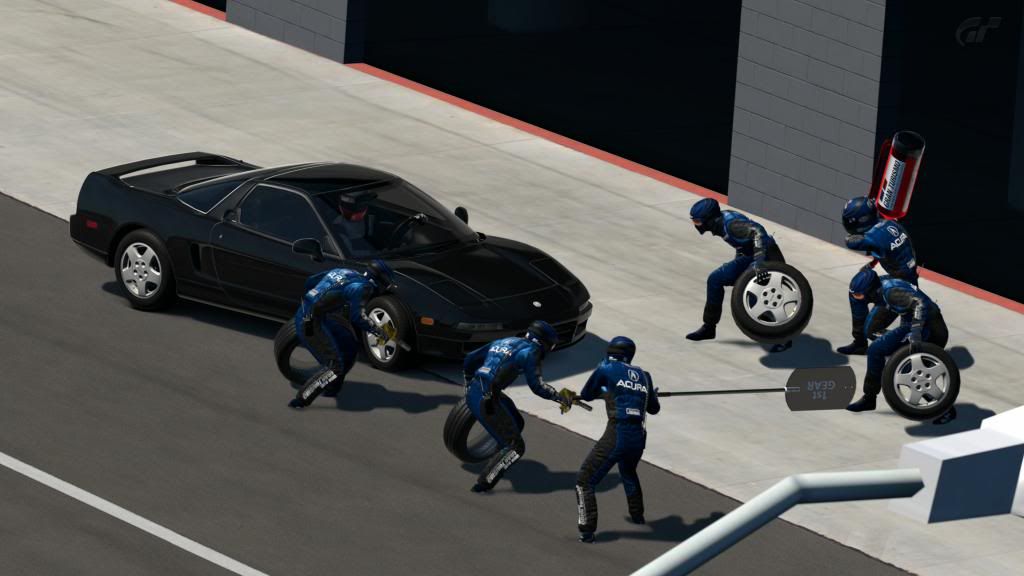
After a quick warm up, I did a hot lap to establish a baseline for performance. On my hot lap, going into the First Curve wasn't a problem, it was the exit that nearly got me, giant plumes of white smoke as evidence of attempted radial homicide. The S Curves were handled a lot easier than I had anticipated, and the nose had absolutely no problems pointing in the right direction. Anti-banked, Denger and Dunlop posed no threat flat out, while 130R required a bit of feathering for a stable entry. 130R ended in yet another puff of smoke, the tyres complacent but very compliant. Given the NSX's reputation for tail happiness, I expected some slide exiting the Hairpin, but with proper throttle application the tyres held up and propelled the car with no sign of drama. Likewise, Spoon is typically tricky, but the NSX stayed mostly flat throughout, shrugging of the challenge and still not sweating. The tail finally slid a little at the exit of the backstretch, but once again the car gave plenty of feedback to know that it wasn't a terminal slide and could be easily corrected. Heaving braking and a twitch at Casio, then a quick jaunt across the start/finish line to the tune of 2:24.702.
After a quick warm up, I did a hot lap to establish a baseline for performance. On my hot lap, going into the First Curve wasn't a problem, it was the exit that nearly got me, giant plumes of white smoke as evidence of attempted radial homicide. The S Curves were handled a lot easier than I had anticipated, and the nose had absolutely no problems pointing in the right direction. Anti-banked, Denger and Dunlop posed no threat flat out, while 130R required a bit of feathering for a stable entry. 130R ended in yet another puff of smoke, the tyres complacent but very compliant. Given the NSX's reputation for tail happiness, I expected some slide exiting the Hairpin, but with proper throttle application the tyres held up and propelled the car with no sign of drama. Likewise, Spoon is typically tricky, but the NSX stayed mostly flat throughout, shrugging of the challenge and still not sweating. The tail finally slid a little at the exit of the backstretch, but once again the car gave plenty of feedback to know that it wasn't a terminal slide and could be easily corrected. Heaving braking and a twitch at Casio, then a quick jaunt across the start/finish line to the tune of 2:24.702.
Although the '93 had a few nervous twitches, it certainly wasn't as "too easy to drive" as Tiff Needell once suggested. Perhaps he hadn't actually found the gas pedal? And don't let those little puffs of smoke fool you, throughout the lap the '93 NSX gave more constant news than an all-day cable news network. If I entered a turn too fast, it'd let me know. Harsh input into or out of a turn? If it wasn't the suspension, steering or chassis keeping me updated, it was the tyres singing a chorus of the damned. Reputation would have you believe that the '93 NSX was nervous, but correct application disproves that by displaying it's responsiveness. It isn't a crackhead going cold turkey, it's more like a sports agent that can actually show you the money. Even though I'm no Formula 1 super star, the time established felt respectable.
After my lap in the black '93, I found it difficult to see how Honda could improve upon an already winning formula. By sourcing Pininfarina early in development, matching the Italians in desireable styling was almost guaranteed. Coupled with Formula 1 and Indycar talent to tackle the handling and suspension characteristics, I find it hard to believe that it could get much better. That's like saying "thanks for turning this water into wine, Jesus, but I think I could do it with a better bouquet." How can you possibly improve the machine when your best testing and measuring equipment isn't around anymore?
No, I promised I... is someone cutting an onion around here?
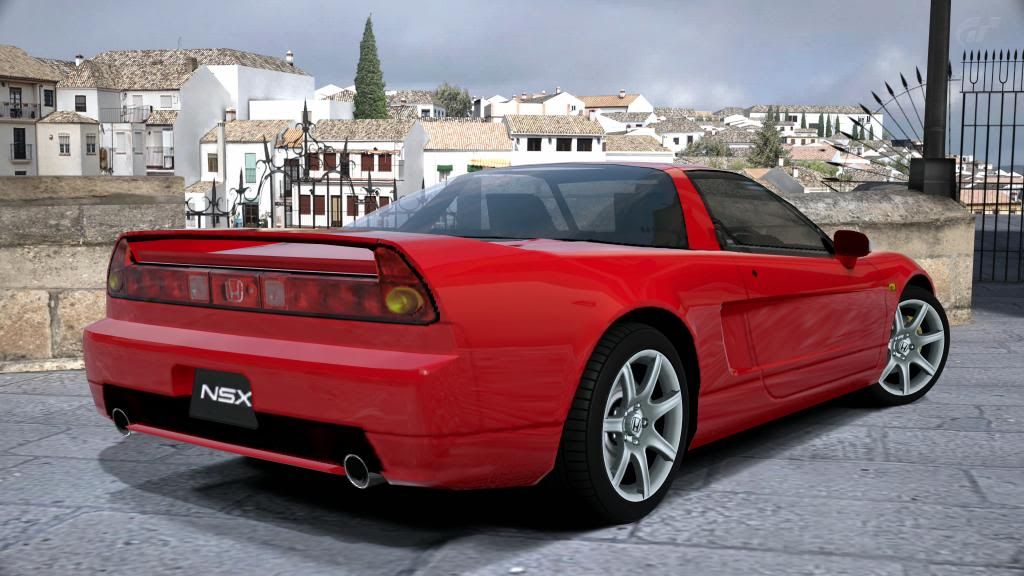
According to Polyphony Digital (via Translator-san):
"The NSX could well be considered Japan's first mass produced supercar. The car underwent its first significant "minor change" in 1999, and then at the end of 2001 Honda designers decided to dramatically update the NSX's styling. The biggest change they made was to the car's front end, swapping the pop-up headlights for fixed rectangular ones. They also reshaped the front bumper, hood and doors, as well as redesigning the taillights and adding a new bumper skirt. To improve the car's road-holding abilities, the NSX's tire size grew to 215/40R17 up front and 255/40R17 at rear, wrapped around 17-in. forged BBS wheels."
"The suspension was completely retuned to accomodate the new tire sizes, and as a result the NSX's handling prowess improved, making it one of the best-handling cars in the world. Not much later, Honda announced the arrival of the NSX Type R."
"Even after eleven years, the basic qualities of the original NSX remained unchanged. This is a testament to the creators of this elegant performance machine. Sure, the displacement of the engine grew slightly, and there was the addition of a 6-gear manual gearbox, but for the most part, the NSX remained true to its original form and formula, making it one of the most timeless machines to ever come out of Japan."
Soichiro Honda was never one to let the tragedies around him ruin his day. In 1944 he had a plant destroyed by a B-29, the next year another flattened by an earthquake. Despite the ravages of World War II destroying practically everything around him, he could still be found riding his bicycles around town by day and drinking with Geisha by night. Like any man, he didn't cry about his company being reduced to rubble, he sold the salvage and used the proceeds to build generators and engines. Although it took some time, Honda didn't stop working after losing their best talent and close friend, they "put it up to eleven."
Aside from the obvious visual differences between the two, the first big change is noticed the moment you start the engine. Ditching the pop-up headlights in favor of lenses is a giant improvement in the I-have-to-live-with-it sort of way, and nearly every early model Corvette owner will attest, a lot cheaper in the long run. While that same Corvette can be found on the side of the road after 100,000 miles, even the '93 still runs like a Swiss watch twenty years later with absolutely no recalls. While the black '93 NSX sounded like a jaguar locked inside a tiny cage, this one sounds more high strung despite only a hundred extra revs at peak horsepower.
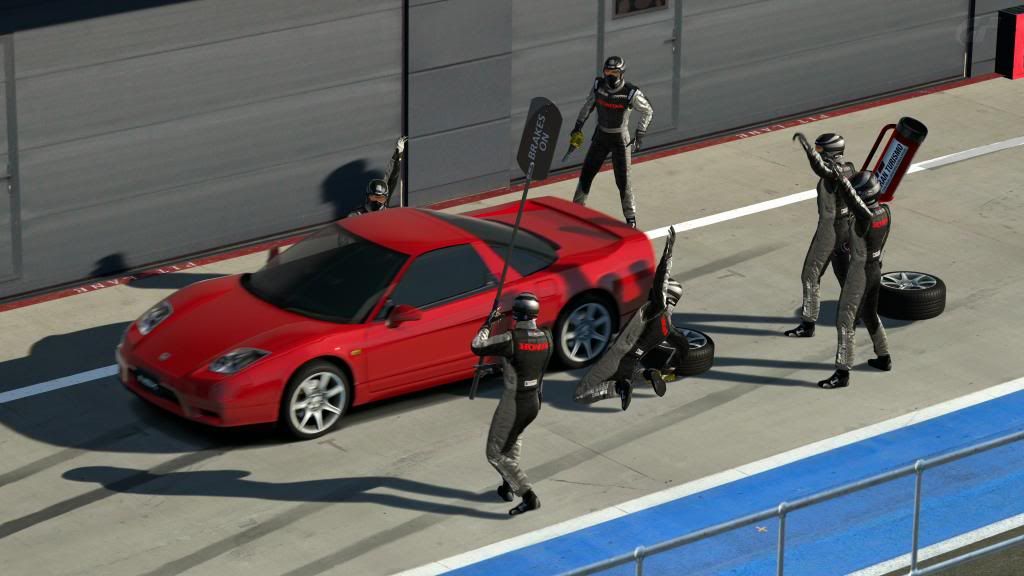
Performance (as purchased): February 21, 2014, New Formula Red (Red) *'01 Honda NSX
Displacement: 3.179 cc
Max. Power: 289 HP @ 7,100 rpm
Max. Torque: 235.4 ft-lb @ 5,500 rpm
Drivetrain: MR
Length: 174.4 in., Height: 46.1 in., Width: 71.3 in., Weight: 1,340 kg
Tires: Sports (Hard)
Performance Points: 457
Mileage: 181.7 mi
In 1997, engineers went mad and started massaging and improving the powerplant, adding even more strength and power. The exhaust was now stronger, lighter, and more efficient, while even more exotic materials like fiber-reinforced metal (FRM) found their way in as well. An extra 182 cc yielded approximately 20 more horses, but the way that those horses were delivered required rethinking even more components. Bigger brakes all around helped reign in the horses, but those too, required increasing the wheels from 15 and 16 in. wheels to 17s. In August of 1998, those modifications were enough to drop the 0-60 mph time by three tenths, at least according to Car and Driver. I typically zone out whenever manufacturers claim that their latest model is "even better than the last", but now I'm honestly intrigued by what the extra horsepower, bigger wheels and brakes, and 10 fewer kilograms are capable of.
I wouldn't have to wait very long. When I returned from my cool-down lap, the Super Best Friends had the red '01 ready to go. Thankfully changes to the interior were minimal, so everything was exactly where it should be, or where I last left it. On my flying lap, I remembered the smoke from exiting the First Curve and prepared for the same sensation fractions of a second before the exit, only this time there wasn't any smoke. The tyres still kept me informed about the available grip left, but the new suspension kept everything planted and pointed in the right direction with even less effort than the '93 before. At the hairpin I found perhaps 10-20 feet of more grip, allowing me to put the power down that much quicker. There were still traces of smoke here and there, but that's only because I was able to carry more momentum through the corners, psychologically rewarding me for pushing harder. When all was said and done, 2:19.899 was on the clock, and almost 5 full seconds were in the bank!
During my cool-down lap and on my way back to the paddock, I had a quiet moment of reflection about what had just happened, the NSX's engine barely audible in the background. I hadn't seen the time yet, but I already knew that this was much faster than the black '93 model, no immediate need to quantify exactly how much, just faster. But... and I know this is odd... I wasn't exactly happy about it. When the NSX was introduced, many Europeans criticized it for lacking character and passion. How they arrived to that conclusion is beyond any measure of reason or logic. Some said it wasn't a supercar because it didn't set out to kill it's driver, but back then that was the typical standard of measurement. Of course, the only people I can think of that believe in losing one's head as a sign of "passion" are the French, and they hardly speak for the whole of Europe.
When I got out of the car, I was greeted by a few Honda representatives as well as Super Aguri, both anxious to hear my first impressions of the cars. Although I had nothing but positive things to say about each, I did my best to decipher and disguise the state of melancholy that appeared within my soul when it was over. Driving the two back to back was like night and day, and during the course of a lifetime, it's only natural to expect improvement and advancement. True enough, the NSX had become more capable, the hard work of it's dedicated craftsmen and technicians had paid off in spades, more than those five seconds are capable in showing in videos or through telemetry. I went faster, so what the hell is wrong with me?!

After we left the track the crew went out for sushi and saki while I returned back to the hotel with all of the equipment. Tonight would be the last night of our consecutive run in Japan, and I should be feeling at least 300 different other emotions instead of the state of confusion that I was actually in. I'd been briefed about each by very knowledgeable people beforehand, well aware of the changes between the two. But when it was over, I couldn't quite tell what that change was or if I even liked it. Instead of dreading the return home to whatever drama awaits, I sat by the pool in a nearly comatose state. I'd been hired to test two very similar cars, but suddenly I found that I couldn't really talk about either without returning exactly to my emotional and mental confusion. I went faster, why couldn't I be happy with that?
In that short time... did I change? Was it something I did? Something I didn't do?
At some inappropriate hour during the night, the crew stumbled back to their respective beds, eager to greet the hangovers and layovers that awaited within hours. Meanwhile, I obsessively scoured the video tapes, first watching the hot laps, then every lap in an effort to sort out my head. Although I was expected to convey my impressions to you, I knew then that it'd never be possible if I came home a complete basket case, trapped within my own mind much like Robert Pirsig once found himself. When the in-car footage failed to yield any answers, I soon moved onto the next angle, followed by the next.
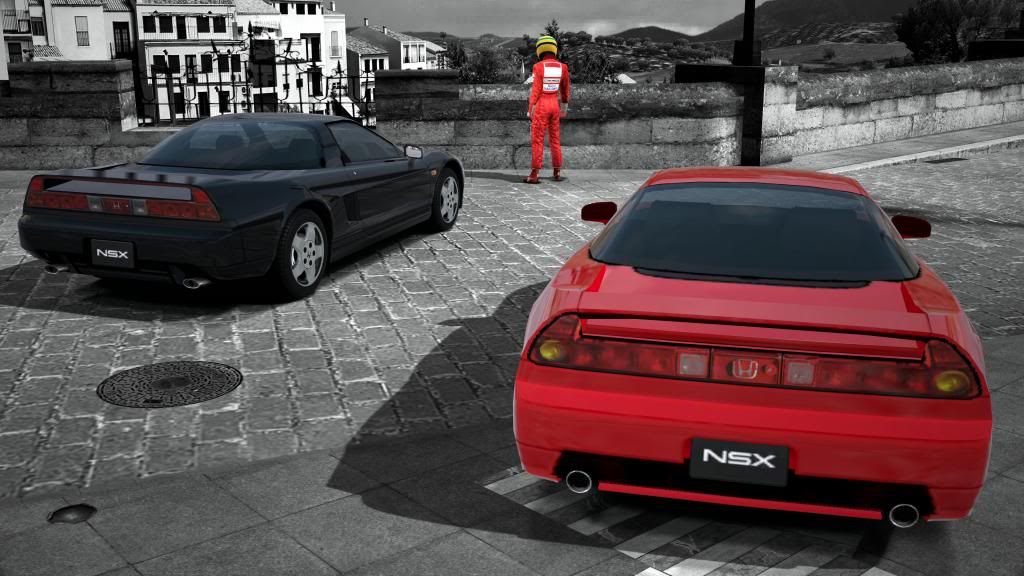
A few minutes before dawn, I tore myself away from the viewing screen, and stepped outside to smoke a cigarette. Also outside was the hotel manager, fluent in English as many of the Japanese are. He must've noticed my confusion, striking up a conversation that I'll never forget. I started telling him about driving the black '93, then the red '01 before coming straight back to the problem of what I thought about the whole mess. The Japanese are ardent Formula 1 fans, rivaling the Tifosi in sheer numbers that makes Italy look like local fan club. I've avoided mentioning Senna this entire time, as every NSX conversation eventually leads to him anyway and there's nothing more that I could add that hasn't already been said before. It wasn't until Manager-san mentioned him that things started to make sense.
After I tested the black NSX, I couldn't fathom how Honda could manage to improve it. When the NS-X project began, it was Senna that suggested an improvement in rigidity was vital to its success. Along with Rahal and Nakajima, Senna also gave handling feedback. Therefore, he was equally responsible for the fun that I had as Honda was. Even though it was faster, the '01 felt a but muted, a bit more neutral and conservative than the '93, and I wasn't exactly sure that the numbness would be something that Senna would've signed off on. Sure, I was able to carry more momentum, but the cost turned out to be the hair-raising excitement that was tuned into the '93. Although better in every quantifiable way, the differences between the two were as different as Senna and Rahal, Indycar and Formula 1.
After that conversation, everything was a lot more clear. Despite adding more horsepower, more acceleration, more stopping and more speed, the ultimate sacrifice had been the soul that was originally crafted into it by the feedback of Senna. After the tragic events of Imola, his absence was still being felt, and here it was also on display. The fact that you'll never match the talent of Ayrton shouldn't come as a shock to anyone, but having obtainable access to his soul was just as good. Considering that, the $90,000 original sticker prices hardly seems unreasonable, and it's still only a quarter of what Enzo would've charged you for an inferior car. Although I very much appreciate going faster, sometimes that simply isn't enough.
Which is odd, coming from a man. Factoring in how Senna changed F1 and Honda changed the supercar, expectations have also changed. Convention would have you believe that so-called "pay drivers" lack talent, and that supercars should be jet set performance machines made completely out of unobtanium, styled by Picaso with Pinkeye, then trained to recklessly murder anyone unfortunate enough to shell out the small fortune just to own one. Yet the facts are that Senna was a "pay driver", the NSX proved that supercars can and should be obtainable, useable and safe, and Honda proved that you didn't need to gouge out an eye just to look at one. The NSX also proved that you didn't need the ridiculous neanderthal machismo. There's no need to "man up" when you're already the Alpha, and the combination of Honda, Senna and the NSX wasn't going to replicated. In 2006, there was no NSX.
It has been said that "it takes a big man to admit when he's wrong". So when I tell you that I haven't shed a single tear about the loss of Senna during this review, I lied each time.
*The views and opinions expressed in this review do not necessarily reflect those of the manufacturer, the publisher, GTPlanet.net or it's members, nor anyone with an IQ above 3. If you have a history of epilepsy or seizures, consult a doctor before use. Certain patterns may trigger seizures with no prior history. Underage sale is strictly prohibited. Before using see the instruction manual included with your system for more details. For previous reviews, please visit: McClarenDesign's Very Serious SLS AMG Reviews of the Car of the Week N Stuff. Void where prohibited. All videos were filmed before a live studio audience. Car setup monitored by Dark Lion Racing's GT6 Tunes and Tricks app on Android, as administered by Super Best Friends Super Aguri. Contains wheat and soy ingredients. No goats were harmed in the making of this review that we are aware of. This product may cause significant hair loss, headaches, and damage to the immune system. Best wishes to Michael Schumacher! To advertise, contact McClarenDesign@gmail.com. If not completely satisfied, please return the unused portion for a full refund. If overseas, please include additional postage. Some assembly required.
-Super Previous Super Reviews-
Insightful...
but bollocks: Introduction To Failure (or How I went from a Very
Serious SLS AMG to Super Best Friends Super Aguri)Week 1: '10 Peugeot RCZ
Week 2: '88 Volvo 240 GLT Estate
Week 3: '87 Buick Regal GNX
Week 4: '57 BMW 507 vs '55 Mercedes-Benz 300 SL
Week 5: '72 Alpine A110 1600s vs '72 Alpine A110 1600s (15th Anniversary Edition) vs '73 Alpine A110 1600s
Week 6: '90 Nissan Primera 2.0Te / Infiniti G20
Week 7: '03 Acura CL 3.2 Type-S / Honda Accord Coupe EX
Week 8: '98 Toyota Sprinter Trueno BZ-R / Corolla Levin BZ-R
Week 10: STAY TUNED!
Feb 23, 2014
Week 8: 1998 Toyota Sprinter Trueno BZ-R / Corolla Levin BZ-R
"That is how he wants to race. It's not racing." -Ayrton Senna
Why on Earth are we still here? (Editor: So you can test another car.)
It's been nearly two months since I've been able to enjoy the comforts of my own bed, in my own house, in my own country. Two months missing my beautiful wife, my wonderful daughter, and god only knows the drama I'll walk into when I get back. Despite my lack of authority over our crew, the car choices or anything else in Japan, I'm sure that I'll shoulder all of the blame the minute I walk through the front door. Even though my wife knows that traveling for long periods is part of the job, I'll still be the one to blame for being gone this long. I can also look forward to all the chores that weren't done while I was away, because hiring someone to cut the grass or fix the garage door defies the whole reason why my wife married me. Quite simply, I'm not much more than cheaper labor.
You might think that's a bit sexist, but then you haven't spent a day with my wife. Everything has its own order and place, and mine is planted firmly beneath her heel. You might think that I'm a bit crazy for willingly participating in such an archaic domestic situation, but it does have its advantages, rare as they may be. You see, my wife has an incredible ability to make meals that delight the soul. If one taste is heaven, then one meal is the entire kingdom of every deity known to man. She's also responsible for the Americans beating the Russians at ice hockey in 1980, the Red Sox breaking their curse in 2004, and the return of the Twinkie. So you see, by every other account she's a saint, her three miracles guaranteed to place here in the great halls of Catholicism, even though I receive the Inquisition for my misdeeds. Or perceived misdeeds. Why do I love her? Well, much like the cars we test, I'm a glutton for abuse. That, and she can do this thing with her tongue...

So why are we still in Japan? (Editor: Because that's where this car was born. At this rate we won't be going anywhere else anytime soon. Do you mind?)
Previously we've sampled the goods of Infiniti and Acura, the Japanese luxury market created for Americans that wanted a gussied-up means of transportation, but lacked the funding to acquire anything conventional. Or they lacked the taste. So you might think that, naturally, we'd go after the third installment of Japanese luxury-meets-freedom fries, Lexus. But you'd be wrong. Although we've just finished with the Toyota factory tour, we'll have none of that badge-engineered garbage this week. This week, we skip the Plaza Accord altogether and get a taste of the apple from The Tree of Knowledge, likely with similar side effects.
The forbidden fruit bequeathed to us this week comes in two flavors, but don't let the marketing fool you. Although they are the same car, the relationship between the two requires that both be made, or none at all. You can select one or the other, but if one isn't available, you're not likely to find the other, either. Sold in separate stores, we've united the complimenting pair in an effort to see if technology really does improve the breed, or if it's a case of too many cooks spoiling the broth. Over any given period of time, does automotive evolution occur according to Charles Darwin, or are we left to ponder the machinations of some invisible man in the clouds, dependent entirely on its mood on any given day? In short, we're testing automobile evolution versus questionably intelligent design.
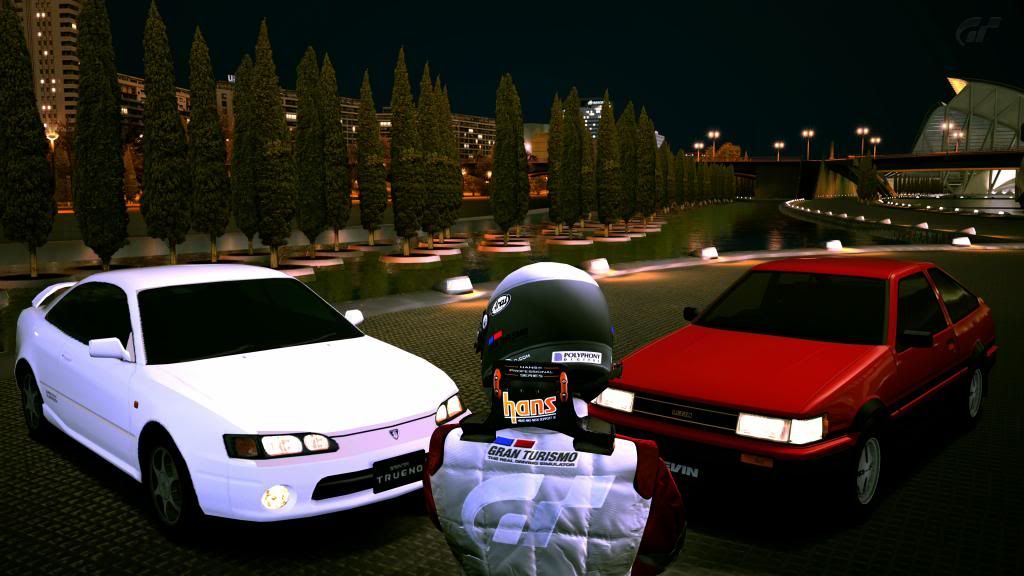
According to Polyphony Digital (via Translator-san):
"A full model change to the Levin/Trueno in May 1995 marked the arrival of the seventh-generation version, also known as the AE111. The AE111 was the complete opposite of its predecessor, the AE101, because it did away with the luxuries that defined the previous car, partly because Toyota wanted to reestablish the model as a sporty brand. As a result the AE111 became a lighter car, thoroughly trimmed down, 70 kg lighter than before."
"There were obvious deletions in the lineup as well. The supercharged engined that graced the model's top lines, such as the BZ-G was gone, replaced by the naturally aspirated 5-valve-per-cylinder 4A-GE. But Toyota tuned this inline-4 to produce162 HP/119.3 ft-lb of torque, essentially matching the output of the previous supercharged engine."
"The suspension system remained basically the same as the AE101, iwth a helical LSD dramatically improving the car's turning abilities. In 1997, the BZ-G was renamed the BZ-R and received a 6-speed manual transmission. The car became a bit heavier at this point because of the implementation of an airbag and other safety equipment required by law. As a result, the car lost its luster among young enthusiasts, many of whom were already beginning to trade in their sports coupes for small SUVs and wagons. In 2000, the Levin/Trueno was removed from the Corolla lineup, marking an end to this affordable enthusiasts-oriented model."
Contrary to popular belief, Darwin never said "only the strong survive." The Tyrannosaurus Rex was plenty strong, but even it couldn't handle the impact of one measly little comet. Instead, Darwin claimed that animals capable of adaption would be the ones that last the longest, which is a good thing when you consider what hunting a T-Rex capable of withstanding a nuclear explosion would be like. The good folk of Japan have even provided examples of such nonsense, each with varying degrees of success. Despite that, I can truthfully say that no part of Japan has been wiped out due to an overgrown lizard from the sea. At least not yet. We're constantly reminded that history shows, again and again, how nature points out the folly of man.
Automotive evolution is no different, and as Translator-san has already said, these cars fell victim to their inability to adapt to their environment. As we mentioned when we tested the Volvo Estate, the 1990s brought with it the peak of the Sports Utility vehicle, itself an evolution of military transport trucks decades before. Although it isn't entirely a new species, you've seen how it's now evolved into crossovers and so called "light utility" vehicles, for people that want the appearance of a SUV without the eco-killing labels that come with them. They also don't want the negative connotations usually associated with estates, even though what they've chosen is undeniably worse than what they actually need. You might call it "natural selection", but the way I see it, nature is a **** that doesn't know what she needs and only chooses what she wants. How can the strongest survive if it isn't pretty enough? Hummer, for instance.
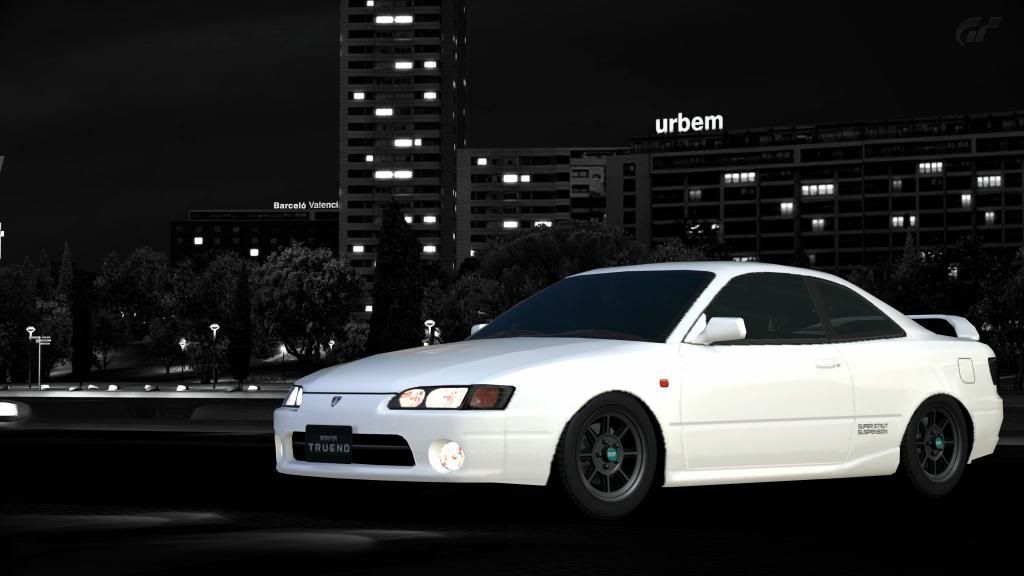
Performance (as purchased): February 15, 2014, Super White II (White) *'98 Sprinter Trueno as shown, but both are the same.
Displacement: 1,587 cc
Max. Power: 193 HP @ 8,800 rpm
Max. Torque: 127.9 ft-lb @ 6,300 rpm
Drivetrain: FF
Length: 169.5 in., Height: 51.4 in., Width: 66.7 in., Weight: 1,080 kg
Tires: Comfort (Soft)
Performance Points: 393
Mileage: 208.4 mi
Why? Are there no cars made anywhere other than Japan anymore? (Editor: There are, but none of them were chosen for you.)
In sports and in life, there's nothing I relish more than being underestimated. Be it racing on the track, playing poker with friends, or even fixing the dishwasher, there's nothing more satisfying from making those that believe "you can't" eat their words. Likewise, it's when we find a car that exceeds our expectations that we know we've found a winner. The Primera, case in point, wasn't expected to be as fun to drive as it was, and the same could be said for the Peugeot RCZ from Week 1. Both are front-wheel drive, yet despite that, they still managed to put a smile across our faces. Rather than bask in the typical stereotype of each, they seem to relish it, as if to say "oh yeah, well I know something you don't". It was with those two in mind that we tested the CL Type-S, and failing miserably, contemplated suicide soon after. Plus, everyone loves cheering for an underdog every now and then.
Even though we expected to test a Lexus based on recent selections, our expectations were tweaked with the promise of something more sporty than luxury. But when we found out that it was the 111, and not the infamous haichi roku, I must admit that the leap to conclusions was of Olympic proportions. Why would Toyota take a simple formula for success and cock it up by making the switch to front-wheel drive? Much as every other enthusiast, we didn't care about the economic implications, and frankly we still don't want to. Having had the pleasure of testing the AE86 once before, I couldn't see why Toyota would change anything about it. Except, the power on tap, that car was perfect in every way. It had seat belts, terrific handling, and could get you down a mountain in little time while making passengers cringe at the sight of the road's edge. Who could ask for anything more?
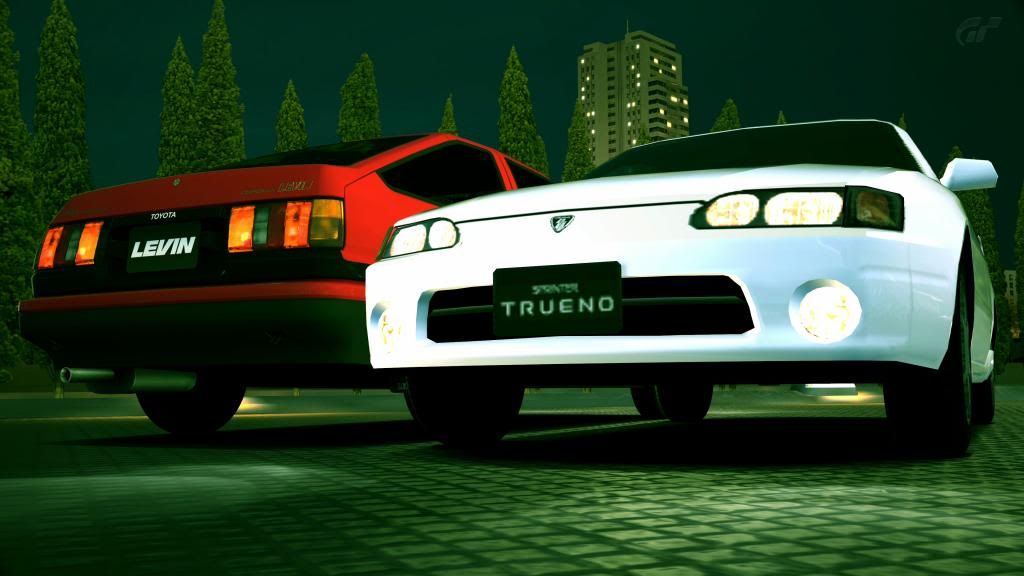
Apparently, the general public. Much as the aforementioned Mother Nature, so too is the public; ***** that don't know what they want. Back home I get loads of questions from potential buyers, each eager for my opinion on what car to purchase next. Every one of those request begins with flowery praise of the insights I've previously offered, but when I make a suggestion it's immediately ignored as if I haven't a clue of what I'm talking about. Doctors don't face this sort of slap in the face when they prescribe treatment for cancer and attorneys don't when they offer legal advice, yet every time I give my opinion about a potential purchase it's as if I were speaking to a brick wall. Actually, I'd probably have better luck with the wall. Despite getting a list of automotive needs and referencing that with available options, whenever someone asks about a car they should buy, I've learned that their mind is already made up and can't be changed or persuaded. Aside from wanting to retain my soul, this is also why I don't sell cars.
So it comes as no surprise, then, that this is the end of the line for the Levin/Trueno. Sad, really, because even though Toyota screwed up the layout in the generation prior, this is actually a very good car. The Corolla name is known worldwide for selling by the boat load, yet after the AE92, these versions weren't offered in America. Available with a 6-speed manual (unheard of today), a boy racer spoiler, ABS, better brakes and something called the "Super Strut Suspension". This combination is more dynamite than "Thunder" and "Lightning", from where the names derive, respectively. Compared with the daft American offerings such as the Escort/Topaz and Cavalier/Sunfire, this car is actually sporty without the need to put silly stickers on the fender or grotesque stripes down the middle. Not only that, but unlike the Topaz and Cavalier, you won't be ridiculed for being seen in one. Although not listed from the factory, "respect" comes standard on each model, so it really doesn't matter which one you chose.
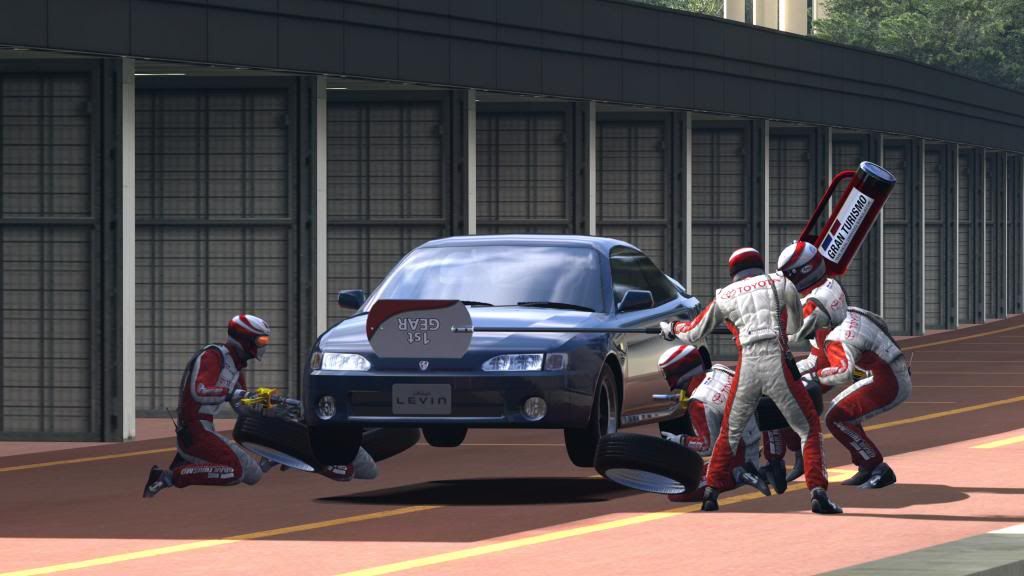
Why don't we have any say in the cars we test? (Editor: You have about the same amount that you have in how much you do/don't get paid. Get on with it!)
While we can theorize and debate evolution and intelligent design for eternity, but to paraphrase famous physicist Niels Bohr, "science works even if you don't believe in it." I've already mentioned my initial misgivings about the change from rear to front-wheel drive as a viable adaptation of the species before us. Plainly it wasn't enough to save it from extinction, perhaps only borrowing a few years before the inevitable visit from the Reapers Grim. Still, having a theory is one thing, but putting it into practice is another entirely. Instead of speculation on the reasons for this adaptation, it is worth seeing them placed side by side to compare the effects. As such, we were able to acquire a few local roads to watch nature take its course. Much like Sir Charles (Editor: not Sir Charles) visiting the Galapagos, we'd be observing evolution and its role in our own automotive ecosystem.
To watch nature take its course, we've selected the Twin Rings of Motegi to pit RWD against FWD. While we would've preferred to sample these cars in their natural environment, we simply couldn't obtain the permits needed and no insurance company on Earth would guarantee funding should one or both end up through the middle of a shop if I got something wrong. Even though we had local heroes Super Aguri preparing the cars and ensuring their safety, it seems that the insurance agencies caught wind of a certain escapade involving a Buick, and wanted absolutely nothing to do with what we had planned. While you might save some cash by visiting their website, I wouldn't expect their support if you happen to document your escapades for the world to see, as we do. "Fund a teenager to flog a car down a mountain? Sure! $57,000, please. That guy? HELL NO."
Up first was the father, the progenitor, the passer of genes, the AE86. Much has been written and said about the legendary abilities of these cars, but I cannot stress enough the "fun factor" that they provide. In order to reach the car's potential, however, they must be driven completely flat out, ten-tenths the entire time. Although there isn't much power, there is enough to keep the car well positioned, quick to react and with enough feedback to rival a CNN ticker at the bottom of your television screen. By today's standards, the car is a bit antiquated inside the interior, but when you're careening sideways down a mountain road, the last thing on your mind is the fabrics and plastics used. Being inexpensive, the materials chosen do their job well, in some cases beating out American cars costing three times as much, like the Corvette. Using every one of the 136 horses on tap, I was able to coax a 1:46.980 from our Levin, which felt respectable even though we hadn't yet had a chance to test its grandchild.
Whenever you see lightning, thunder is usually soon to follow, so naturally we chose the Sprinter Trueno to follow up behind the Levin. The difference in layout didn't really take much to get used to thanks to the cars we've previously tested from Nissan and Honda. Even though the Trueno has a similar differential to the Honda, this tricky diff did what the Honda couldn't... it turned. For a front-wheel drive, it actually turned well, the radius of which being completely predictable and manageable. In the Honda you had to guess the entry speed before making an attempt, and that was after you'd scrubbed off what you hoped would be enough speed to see the other side. Conversely, the Trueno carried the momentum throughout the turn, occasionally suggesting that a faster response mid-turn would yield a better exit. If the Honda could be compared to a dog dragging its arse across a lawn, the same could be said of the Trueno, only as a cat instead. Even though it weighs more than the AE86 Levin, the extra mass doesn't feel like an encumbrance, gliding through turns like a ballerina on her toes. The stopwatch and my derriere both agreed, the 1:43.908 was faster.
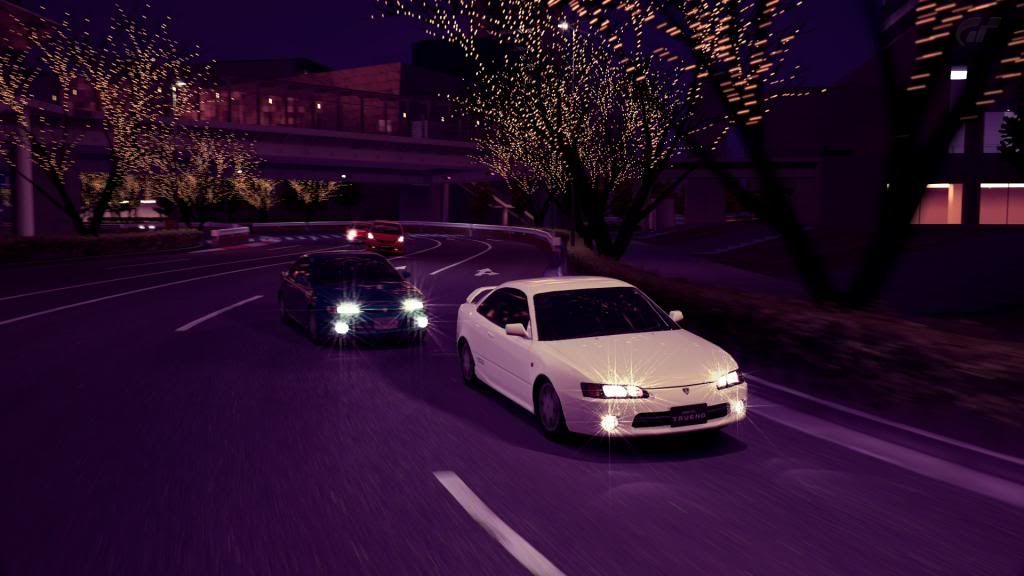
Why doesn't this make any sense? (Editor: Probably because you can't be trusted to choose anything other expensive hypercars with unpronounceable names. Keep going, we haven't got all day!)
No, I mean why doesn't the evolution make any sense (although we'll discuss that when I'm finished)? Logic dictates that the switch from rear to front-wheel drive would ruin the car by limiting its capabilities. It's safe to assume that had this been rear-wheel drive, we'd likely would've shaved off even more time than the three whole seconds we already have! That'd place the Trueno in musclecar territory, and before you protest, let me remind you that the Mustangs and Camaros of the era had similar power output. The horsepower gap between this and the AE86 would be about the same as between it and the Mustang GT, yet I'm sure that extra horsepower in the GT would be wasted by the live-axle in the back, and that this Trueno would still end up with a better time!
Therein lies what nearly every enthusiasts skips over, simply because it isn't sexy and has no perceived relationship to going faster. Economics. In motorsport, the speed you travel is only limited by the budget you offer, and when making a car the same is true. Compared with rear-wheel drive cars, front-wheel drives have less components, which equals costs savings. Although the Plaza Accord is often credited with the creation of the Japanese luxury market, it's also the cause of what eventually killed the Trueno. The whiplash effect and unintended consequences of the Plaza Accord lead to an economic shortfall, which could've been foreseen had the automakers produced all of their cars in America, much closer to the raw materials needed to do so. In most cases, they didn't, requiring raw materials to be imported before a car could be created and exported. It wasn't as if Japan was going to stumble across a mountain of ore they didn't realize they'd had, like the manner in which you might find extra cash in the pocket of a winter coat. With the boom comes a bust, and this bust took cheap RWD fun with it, and is currently in the process of also taking the manual transmission.
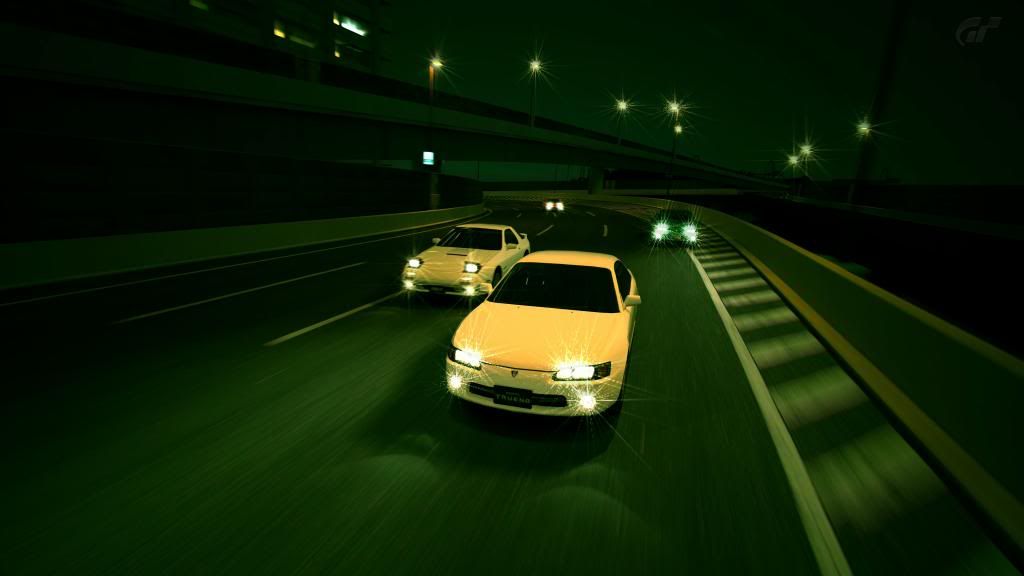
Why can't we get someone to choose cars from another country? (You were applied to be a presenter, not director of Human Resources, remember? Wrap it up, it's time for lunch!)
In 1926 Sakichi Toyoda founded Toyota, then a textile company known for various patents on automatic looms. It was he that introduced the concept of Jidoka, meaning autonomous automation, and this meant that when a production machine had a problem it'd simply stop itself. Before then, many accidents occurred when workers failed to notice quality issues, resulting in machinery run amok and lots of explosions. He also gave us the 5 Whys, an important tool used to get to the root cause of production problems and ensure their prompt correction, which is still being used today in many, many other industries. He also gave us Kiichiro Toyoda, his son, who would go on to create the automotive branch that still produces cars today. By disassembling and dissecting a Chevrolet, he and his team were able to reverse-engineer a car and create a production process, improving it constantly. This eventually enabled a young Soichiro Honda to continue piston rings, later becoming Toyota's automotive rival.
Competition is directly responsible for evolution, and it's the brave that welcome competition and improvement. While this may be the end of the road for the Sprinter and Trueno, evolution has once again crept up to offer adaptations to fit the environment, and the new GT86 species now fills the void left by the AE86. Even Subaru's BRZ carried over a few letters of the name, albeit in a different order, it's still practically the same as the GT86. That's a good thing, because we've been without an underdog like this for quite sometime, and without them, we'd never learn the speed of lighting and roar of thunder. These cars and I share a kinship, in that we'd love for you to underestimate us both... at your own peril.
Why can't we go home? (Editor: You'll find out next week.)
*The views and opinions expressed in this review do not necessarily reflect those of the manufacturer, the publisher, GTPlanet.net or it's members, nor anyone with an IQ above 3. If you have a history of epilepsy or seizures, consult a doctor before use. Certain patterns may trigger seizures with no prior history. Underage sale is strictly prohibited. Before using see the instruction manual included with your system for more details. For previous reviews, please visit: McClarenDesign's Very Serious SLS AMG Reviews of the Car of the Week N Stuff. Void where prohibited. All videos were filmed before a live studio audience. Car setup monitored by Dark Lion Racing's GT6 Tunes and Tricks app on Android, as administered by Super Best Friends Super Aguri. Contains wheat and soy ingredients. No goats were harmed in the making of this review that we are aware of. This product may cause significant hair loss, headaches, and damage to the immune system. Best wishes to Michael Schumacher! To advertise, contact McClarenDesign@gmail.com. If not completely satisfied, please return the unused portion for a full refund. If overseas, please include additional postage.
-Super Previous Super Reviews-
Insightful...
but bollocks: Introduction To Failure (or How I went from a Very
Serious SLS AMG to Super Best Friends Super Aguri)Week 1: '10 Peugeot RCZ
Week 2: '88 Volvo 240 GLT Estate
Week 3: '87 Buick Regal GNX
Week 4: '57 BMW 507 vs '55 Mercedes-Benz 300 SL
Week 5: '72 Alpine A110 1600s vs '72 Alpine A110 1600s (15th Anniversary Edition) vs '73 Alpine A110 1600s
Week 6: '90 Nissan Primera 2.0Te / Infiniti G20
Week 7: '03 Acura CL 3.2 Type-S / Honda Accord Coupe EX
Week 9: STAY TUNED!
Feb 18, 2014
Week 7: 2003 Acura CL 3.2 Type-S / Honda Accord Coupe EX
"It is the head and not the foot that is instrumental in any one driver's achievement." -Peter Sauber
Mistakes happen. From an early age, we're taught that things aren't always going to go as planned. Milk gets spilled, homework gets forgotten, alarm clocks don't get set, toast gets burned and American Idol is still on the air. Along with this lesson comes with how to respond to those mistakes. If you're an individual with any sort decency or character, you own up to the mistakes and acknowledge responsibility. It's called integrity, and if you intend on having any amount of peace and harmony in your life, it's a survival trait.
When you're on the receiving end of an error, an apology is rightfully expected. Not having that expectation allows one to be trounced upon, and it also enables the injustice to continue onto the next man. If you don't hold others accountable, then mistakes become rampant and irreparable. A prime example of this would be Eric Snowden. Regardless of how you feel about his decision or the way it was carried out, he was the only American brave enough to not only speak out about an injustice, he also brought along enough evidence to convince foreign leaders and earn political asylum. By speaking up, he also gave America the precise length of rope required to hang itself when it botched the response, losing the minute amount of credibility they had left.
![[IMG]](https://lh3.googleusercontent.com/blogger_img_proxy/AEn0k_tVEuks9R-YXEZI6ZlblO1TDYtD-yc_vNjDT6NqL2EwDvemj_iGTMGwzYPnG1s2_RzK6HLXhDewDV8tp8huUjPmKYECBUQTkwhTLxWkgoshZ_bZfcbYyTgX2ybs3egkjg_9sZ-tSBVz_DsV5Svm7ysE2R4UL1RgyNit4gWIAm8Cput9LUM=s0-d)
Integrity is the ability to admit when you've made a mistake, apologize for it, and work to correct it. While the concept sounds wonderful, the way in which we as a society demand it isn't the same as who we expect it of. When an order is wrong at a restaurant, there's absolutely no hesitation in sending it back, yet politicians are allowed to accept gifts and bribes with nothing more than a wink and a handshake. Soda machines get punched for excess coins swallowed, yet that same person will happily sign a multiple-decade mortgage that will eventually bankrupt them. Today it's quite rare for someone to stand up and say "wait a minute... this just isn't right!"
It's the same in automotive journalism. People depend on us to deliver factual information and opinions, experiences and sensations they haven't yet got. There's an expectation of credibility, a trust that's freely given, in the hopes that maybe the reader will gain some insight and wisdom when faced with an automotive question. Your chances of driving a 1957 BMW 507 might be slim, but if you do ever get that chance, having read the article from Week 4 might help give you a realistic expectation. Yet when you open that latest issue of Automotive Trend & Track and see countless ads for the same manufacturers, you consequently also lend those same manufacturers the same credibility, and any thought of accountability flies right out the window. Doyle Brunson once quipped "If you can't spot the sucker at the table in the first five minutes, the sucker is you", and you only prove his point exponentially by renewing your subscription.
![[IMG]](https://lh3.googleusercontent.com/blogger_img_proxy/AEn0k_vCkci3w3s1znfg7MnWb_cjC78F6clFRkAPABQuYW7f6VDk5BDHEvuLn4DP-PBiuO-6BbPiKmTmN-lSjouDo2x_6ZoH0wJHyiGxppyA7WhfKyZhCD6qsJIg2Wdql2gNNhsVDlXHUCi0H5V9Ojs-s3eZZaF2w7sT0Kb6=s0-d)
According to Polyphony Digital (via Translator-san):
"The star in Honda's U.S. lineup has always been the Accord. It has a long history as being one of the best selling vehicles in the country. But in Japan, our Accord (fourth generation) went by a different name. The Japanese called this car the Inspire. The reason for this was that our Accord had grown to become one class size larger than the Japan-market Accord, measuring 187.5 inches, 71.4 inches and 55.7 inches, overall length, width and height, respectively."
"Powering the U.S. Accord/Japan-market Inspire was a 157 HP 2.4-liter 4-cylinder or a 236 HP 3.0-liter V6. The EX-grade Accord was the sportiest model, thanks to a 6-speed manual transmission working in concert with the V6. Although this engine featured single-overhead camshafts instead of the more sophisticated dual-cam, it nonetheless produced a hearty low- and mid-range punch and smooth revving character. In fact, it was as efficient as any DOHC powerplant from Nissan or Toyota."
"The interior of the EX was just as sporty as its exterior styling, thanks to a three-spoke sport steering wheel, nicely outfitted carbon-fiber print trim on the dashboard and the same shift knob as the one found on the Honda S2000."
"The Accord was not an all-out street racer, but a very refined highway cruiser that provided a comfortable ride for its occupants, while allowing the driver to enjoy periodic stints on his/her favorite mountain road."
For this week, we've been handed two badges from one company, and asked to compare and contrast the them. Both badges conjure up demographic focus group buzzwords like "quality", "luxury" and "dependable". For most, the moment anyone says the word Honda in any given room, someone else will smile, completely convinced that "you meet the nicest people on a Honda". Ever since the oil crisis of the '70s, Honda has managed to cultivate a well-earned reputation for creating machinery that does exactly what it was designed to do, time and time again without failure. On the freak occurrence of a failure, they've been known to go out of their way to set things right.
Unlike every other company since the dawn of time, Honda has never shied away from failure. When a young Soichiro Honda finished with his university studies, the first thing he did was to purchase the equipment needed to manufacture failure repeatedly. Having left his university studies with only one course passed, his failure wasn't for lack of preparation, it was of divine epiphany. While the rest of his classmates toiled away reciting useless bits of information, Soichiro was mastering the craft of forging piston rings, each failure embraced and nurtured as if it were a child. So despite their reputation for quality and reliability, Honda was built on the bedrock of failure.
![[IMG]](https://lh3.googleusercontent.com/blogger_img_proxy/AEn0k_uK5yoEyEYW44egT6ShW4pH0G2MI5cEoVel1Z82FZae27lhl8AenLSz8Jg42hy3droTIPPIM-LcwkGi7Kc-P8ZxBgAu7q76Jtsh2wx_WrpbJCB1COUCPYcBSt3zvPGw5c7xa64lignt5E_hRRU7rH2uO762RG1gcB4be-wFL2p1wA=s0-d)
Performance (as purchased): February 9, 2014, San Marino Red (Red) *'03 Honda Accord EX
Displacement: 2,997 cc
Max. Power: 239 HP @ 6,000 rpm
Max. Torque: 211.9 ft-lb @ 5,000 rpm
Drivetrain: FF
Length: 187.6 in., Height: 55.7 in., Width: 71.3 in., Weight: 1,481 kg
Tires: Comfort (Soft)
Performance Points: 421
Mileage: 46.7 mi
With each failure came insight into the cause, and with that, an insight into preventing it. By sampling the various forms of failure in all of their glory, Honda was able to produce piston rings that were strong enough to meet and eventually exceed Toyota's expectations. Masters of trades dedicate their entire lives learning how to do one thing right, but by learning how to do everything wrong Soichiro became an artist and a true craftsman. Before Toyota, the rings that were made weren't sold, so any mistakes required no apologies. Once under contract, however, those mistakes became top priority. Although Soichiro was never accused of being bashful or timid, his integrity and willingness to accept and correct failure is what gave him credibility amongst the influential zaibatsu Mitsubishi, which eventually financed nearly everything Honda is today.
Despite economic hardships of the past, Honda is almost printing currency these days, and part of that formula for success includes the Accord. With the help of The Fast and Furious and a wealth of aftermarket accessories, previous generations of Accords can provide countless examples of poor taste when modified, yet are completely stealth when left alone. Why send an airplane with bombs into a war-torn nation when you can drive in complete obscurity and in plain sight? Despite their camouflage nature, properly spec'd Accords can deliver a fun drive that challenges their rear-wheel drive counterparts. Because they're relatively inexpensive, you can find them slightly used with no problem at all, much like ordering a pizza.
I was absolutely thrilled at the prospect of testing the '03 Accord Coupe EX, especially since it was the sportier version available at the time. Having previously invested in Honda's failed attempt at Formula 1, I was ecstatic when I learned that our car contained a V-TEC engine, which I assumed would provide a little bit more "oomph" when reaching the top end of the rev counter as in past models. But when I sat in the driver's seat and noticed the manual transmission sitting next to me, it was as if a choir of angels had delivered the messiah before me... to abuse.Then someone said "go". To be honest, I don't remember who or what, and I didn't really care. There were a bunch of other things I didn't care about as well, such as everything in the interior. Nothing felt out of place, fragile or unintelligible, which is the nicest thing I could ask for in an interior. Honda engineers spend countless hours studying the way people drive so that they could design the seats accordingly. I didn't care. Multiple people clocked-in and out day and night to slave over the cup holder design. I didn't care about that either. Rear seating? Probably there. Glove box? Who knows, I couldn't be bothered. The only two things I was concerned about during the lap was the finish line to cross, and the 2:06.715 displayed on the stopwatch at the end.
![[IMG]](https://lh3.googleusercontent.com/blogger_img_proxy/AEn0k_vhZR3Ia0eIRKmPl6zN6JGadTi2bV_DN3Ge7Imm3GxxtX7eQiw1niGrc0ODSXL92qHK5SqLFJsu1Kjrmk6cGiF6J1dQwL7UAuURFXzK59QOhd6mx6MTy5eUZ5y94FUmUAMGTxa3o-_ertU_0YblU_gML1Sq3Oy8-_MyN_Ngmth2yA0=s0-d)
When we reviewed the Primera, we mentioned the formation of Infiniti as a direct result of the Plaza Accord (as opposed to the previously tested Honda Accord). The first to take advantage of the new agreement was Honda, having previously invested an entire decade into researching the concept. If Infiniti was likened to BMW, it could be argued that Acura was Honda's answer to Mercedes-Benz. Although new the the American luxury auto market, Honda was familiar with Americans since introducing its motorcycles decades prior on the west coast. Likewise, having proven their integrity with those same motorcycles, and later with cars during the oil crisis, Americans welcomed Acura with open arms and purchased over 109,000 Acura cars in their first full year of sales.
To put that into perspective, BMW only sold 64,000, and Mercedes-Benz 78,000 that same year. Outselling established brands in the first year flipped the industry upside down, forcing Nissan and Toyota to proceed with their own luxury brands while Mazda opted out of its Amati concept. Even well-established domestic makers Buick and Lincoln took notice, watching potential customers of each drifting across the street to one of the 60 new dealerships across the US. As Honda had changed the public's perception of motorcyclists, they now offered Honda quality with European luxury, and most importantly, affordability. To quote one of their earliest commercials, "this may be the best result we've ever had".
![[IMG]](https://lh3.googleusercontent.com/blogger_img_proxy/AEn0k_vU3PPcRSitpNTGQNHQQ4PxVTT-tczTCqjZwdtr9HkOm6VhXG3mTq1KP40-AniOn053QOs1r_-HtxydpRvWBJ90d5_4dHIlMoU3DbnylY5hmo3MbUj2YV5KNkcXAPzLRZeBVIOU1K5xLJ3ykRU9JuMYN4KS1IoL8u6BcXA=s0-d)
According to Polyphony Digital (via Translator-san):
Perhaps it's around this point that the deception of Acura begins, or at least the perceived deception. In 1999 the CL's sister, the TL, was redesigned completely. In March of 2000, only three months into the new year, Acura unveiled the new CL and dubbed it a 2001 model, completely forgetting the remaining months on the calendar. Theoretically you could purchase a new model and experience nine more months of depreciation before the ball officially dropped for 2001. It was also in 2001 that Acura introduced the RSX, which was nothing more than a mislabeled Integra, before being dropped five years later because the luxury mark didn't want to be associated with the teenage hooligans snatching them up.
![[IMG]](https://lh3.googleusercontent.com/blogger_img_proxy/AEn0k_sew_Sx0IzTvJEJ7cbs8N0MMhQ0qHlr6MJNBfi-NZhg_WZ9tWDdjWZblU0HJEY3pL2JDIFdgITLP1vvN49QtDAZlph7RyupmQOCu6t77Ygzs-7NmGY_Lwzx0uu75iUyOhkDcKunY40f9NTTY7ADk7kCzcDXPfAeJ-_vPNWzNm__rPM=s0-d)
Performance (as purchased): February 9, 2014, Tafetta White (Guess.) *'03 Acura CL 3.2 Type-S Displacement: 3,210 cc
Max. Power: 262 HP @ 6,000 rpm
Max. Torque: 234.4 ft-lb @ 3,500 rpm
Drivetrain: FF Length: 191.9 in., Height: 53.3 in., Width: 70.6 in., Weight: 1,563 kg
Tires: Comfort (Soft)
Performance Points: 419
Mileage: 94.3 mi
Despite being nearly identical to the Accord, there are noticeable differences between the two that are important. While the Accord EX received the J30A4 engine, factory rated at 239 HP, the upscale CL got the J32A2 engine making 262 HP, despite adding only 213 cc. With the added luxury trim and interior, the Acura is 82 lbs heavier. The Accord that has the better power-to-weight ratio, coming in at 6.20 HP-per-kg vs the CL's 5.97 HP-per-kg. Although it's 4.3 inches longer, it's 0.7 inches thinner and 2.4 inches lower than the Accord.
Despite having different engines, both have Honda's patented V-TEC technology, and both are SOHC. The J32A2 was based on the NSX's C32B, though it lacked the proper layout (the C32B being mid-engined, rear-wheel drive) and exotic materials used in the supercar, to save on production costs. While that might not mean much to the average luxury buyer, it means everything to Honda enthusiasts, of which there are many. The uneducated of which will swear that the V-TEC produces more power in the higher rev range compared to traditional SOHC or DOHC (Single or Dual Overhead Cam) engines, but that isn't entirely correct. Instead, the timing is optimized for either high or low rpm use, creating more efficient power but not exactly a higher number. While this can save you trips to the pump, explaining it requires a PhD and a few hours of nothing better to do. Mention the CCVC and no one speaks because they don't have a clue. But when I say "V-TEC", well then everyone loses their minds!
Another highly praised feature of the CL Type-S was its new helical limited-slip differential, which transfers power between the two front wheels to prevent wheelspin. By all accounts, this tricky diff should help the front-wheel drive Acura handle more like a rear-wheel drive, but no amount of differential black magic is going to prevent the front tires from being handed the Herculean task of acceleration, deceleration and lateral grip typically distributed evenly in other layouts. With a front mounted engine and rear-wheel drive, acceleration is applied when the rear tyres reach the apex of a turn, allowing the car to understeer out in a safe manner while utilizing all of the available horsepower. In a mid-engined rear-wheel drive, the distribution of weight between the front and rear wheels allows for faster yaw adjustment, much like using the rudder on a boat or airplane. Again, this helps the driver understeer out of the turn in a safe manner, while providing extra time for input correction should something go wrong before the entry of the turn.Front-wheel drive, however, is another beast entirely. Imagine your dog dragging his arse across your lawn, and you'll have an accurate representation of the concept. While the aforementioned layouts split the acceleration/deceleration and turning between the front and rear tyres, or in the case of the Oullim Spirra, between all four tyres independently, the front-wheel drive is tasked with both. Go into a turn to fast and you simply won't, instead plowing into whatever is directly ahead as though you've never turned the wheel. Despite the Accord and CL Type-S having the same handicap of the same layout, and despite the CL winning virtually every statistic on paper, the difference was night and day. On the Tokyo streets, any power advantage had to be immediately be scrubbed off before going into the next turn. Despite having the better power-to-weight ratio and being thinner, it felt fatter and lazier, as evidenced by the 2:08.804 on the telltale stopwatch.
![[IMG]](https://lh3.googleusercontent.com/blogger_img_proxy/AEn0k_uwlTIuVajmWDOqdLpimmqnWH6xIAt61r1_3G0B943d6Ejn6ZbrgQEgzD3VCRzuffBwAjPgpWfIHJpZvHo9bCifw8eceJfloAaTIWTsWmxlHrxJzqQlzN_yOG4FMqBjXTL0kCPDTk3aoaFq3KEJHqZDIFKd6feJ9fczzBiYw-M9qCBA9frbdYhKJw=s0-d)
If Mercedes-Benz was the target for Acura upon its introduction, they certainly nailed it with the CL Type-S. Although I was just as comfortable in the Accord, the Type-S has been praised all over for its level of comfort, ergonomics and finish compared to the much-more-expensive Germans. From a purely performance perspective however, it's the turn-in... or lack of, that cements the comparison. However unlike the Acura, with the Benz you can apply more power, freeing the back end from the constraints of physics and place the car where it should've been to begin with. Conversely, I've compared the turn-in of the rival BMW to a terrier diagnosed with ADHD... on cocaine. Just as the dog would flinch and instinctively react, so will the BMW the moment it thinks that you're going to throw a stick or ball.
Then there's Audi, which actively tries to be so different than the other two that it can't decide what it actually does want to be. While neither Lexus, Infiniti or Acura offer sedans or coupes with all-wheel drive Quattro, Japan doesn't exactly need to because that niche is filled by Subaru. Although they might not be considered as luxurious as the Audis, Subaru has never lost touch with who they are or how their cars should feel. Even though the BRZ is RWD and not AWD, it still has that "STi-me" Subaru-ishness that endears it to enthusiasts. What it may lack in luxury, it makes up for in what it says about you as an owner; fun, energetic, adventurous and nigh invincible on ice. But if you're ever seen behind the wheel of an Audi, the only thing onlookers will think of you is one word: cock. Are you really going to spend $40,000 on that kind of image amongst complete strangers?
Look, I tried, okay? I wanted to believe again. I wanted to experience the same fun I had the first time I rode in a third generation Accord, darting around and about as if connected on rails like a roller coaster. I wanted to believe that because there was a manual transmission, someone actually cared about what enthusiasts thought. I tried desperately to find the extra time on the track that all those statistical numbers said was available but wasn't. I was even willing to accept the blame for this whole failure and own up to being a pathetic driver, but when our cameraman nearly drove into a barrier on his third attempt, I realized that the only think keeping me from beating that extra time was the car itself.Apparently, I'm not alone in that regard. 2003 was the final year of the CL, and many owners experienced reliability issues. In 2006 Honda settled a class action lawsuit over their automatic transmissions, despite issuing a recall two years prior. As a result, warranty coverage was extended, however many more owners experienced problems well after that extension had expired. Over half of the transmission failures occurred on vehicles with less than 90,000 miles, and one fifth of the transmissions had problems before 70,000 miles. If this was meant to endear Americans to a Japanese luxury product, it isn't working, as Americans can already get that same quality from any other domestic maker.
![[IMG]](https://lh3.googleusercontent.com/blogger_img_proxy/AEn0k_v-FCMHoFoAu5HfpHQQPYClUGAPESMWRduVy6eVpvwnW7ENKyS-jeRnX1xr5tLAJMugNddz8H0aMd-JurmRR94Miz-1ItzbP6C4VgaDAHXuv7h2Mf0-rVg-fIvFIN8geKZUA4Yji9Ja2w61DkbXzBDk47DjfQzsDAunmg2-14CswHcxVs1aG6LuWBQB=s0-d)
I really would like to tell you that things get better from here. Having once had a vested (technically) interest, I also wanted to see Jensen Button win in his Honda. Instead, I'm left to report that Jensen's championship year was the year after Honda quit, and the team became Brawn GP (now Mercedes AMG Petronas). While I understand that every automotive manufacturer is going to produce the occasional lemon, what I don't understand is why I'm expected to pay for it. Previous owners with transmission problems didn't get replacement parts and labor free of charge, it was split with the factory, much in the same manner that a drug dealer expects you to share what you've just purchased. (Editor: What?!?)
At least there's hope for the future. The 2012 Honda Civic was released and for the first time ever, failed miserably. Instead of being the typical darling of the automotive world as in years past, it was panned by both buyers and the media. In 2011, Wall Street Journal writer Dan Neil said "Still, they do not burn with Honda's once-routine over-achievement, and the ire the company faces reflects the high expectations and great trust consumers have placed with the brand. In other words, merely decent feels like a betrayal from Honda." That's fairly accurate, and a little over a year later, their CEO admitted that there was a problem, and that Honda was working to fix it. Having lasted for nearly 73 years, Honda's credibility is now in doubt. Do they embrace this failure, as Soichiro did with his rings, and learn from it in order to become artists? Can Acura survive as a result, and will the new NSX be the renaissance of performance for the brand? Will they ever actually get Acura in Japan, and will it work? I f they're going to stand a chance, they'll have to win over those they've spurned before, and they'll need to do it utilizing the power of dreams, the same thing that drew us all to them to begin with.
In the meantime, I believe I'm owed an apology for being subjected to this unnecessary foolishness.
*The views and opinions expressed in this review do not necessarily reflect those of the manufacturer, the publisher, GTPlanet.net or it's members, nor anyone with an IQ above 3. If you have a history of epilepsy or seizures, consult a doctor before use. Certain patterns may trigger seizures with no prior history. Underage sale is strictly prohibited. Before using see the instruction manual included with your system for more details. For previous reviews, please visit: McClarenDesign's Very Serious SLS AMG Reviews of the Car of the Week N Stuff. Void where prohibited. All videos were filmed before a live studio audience. Car setup monitored by Dark Lion Racing's GT6 Tunes and Tricks app on Android, as administered by Super Best Friends Super Aguri. Contains wheat and soy ingredients. No goats were harmed in the making of this review that we are aware of. This product may cause significant hair loss, headaches, and damage to the immune system. Best wishes to Michael Schumacher! To advertise, contact McClarenDesign@gmail.com. If not completely satisfied, please return the unused portion for a full refund.
-Super Previous Super Reviews-
Week 1: '10 Peugeot RCZ
Week 2: '88 Volvo 240 GLT Estate
Week 3: '87 Buick Regal GNX
Week 4: '57 BMW 507 vs '55 Mercedes-Benz 300 SL
Week 5: '72 Alpine A110 1600s vs '72 Alpine A110 1600s (15th Anniversary Edition) vs '73 Alpine A110 1600s
Week 6: '90 Nissan Primera 2.0Te / Infiniti G20
Week 8: STAY TUNED!
Subscribe to:
Posts (Atom)